
Greetings from Adullam Consulting.
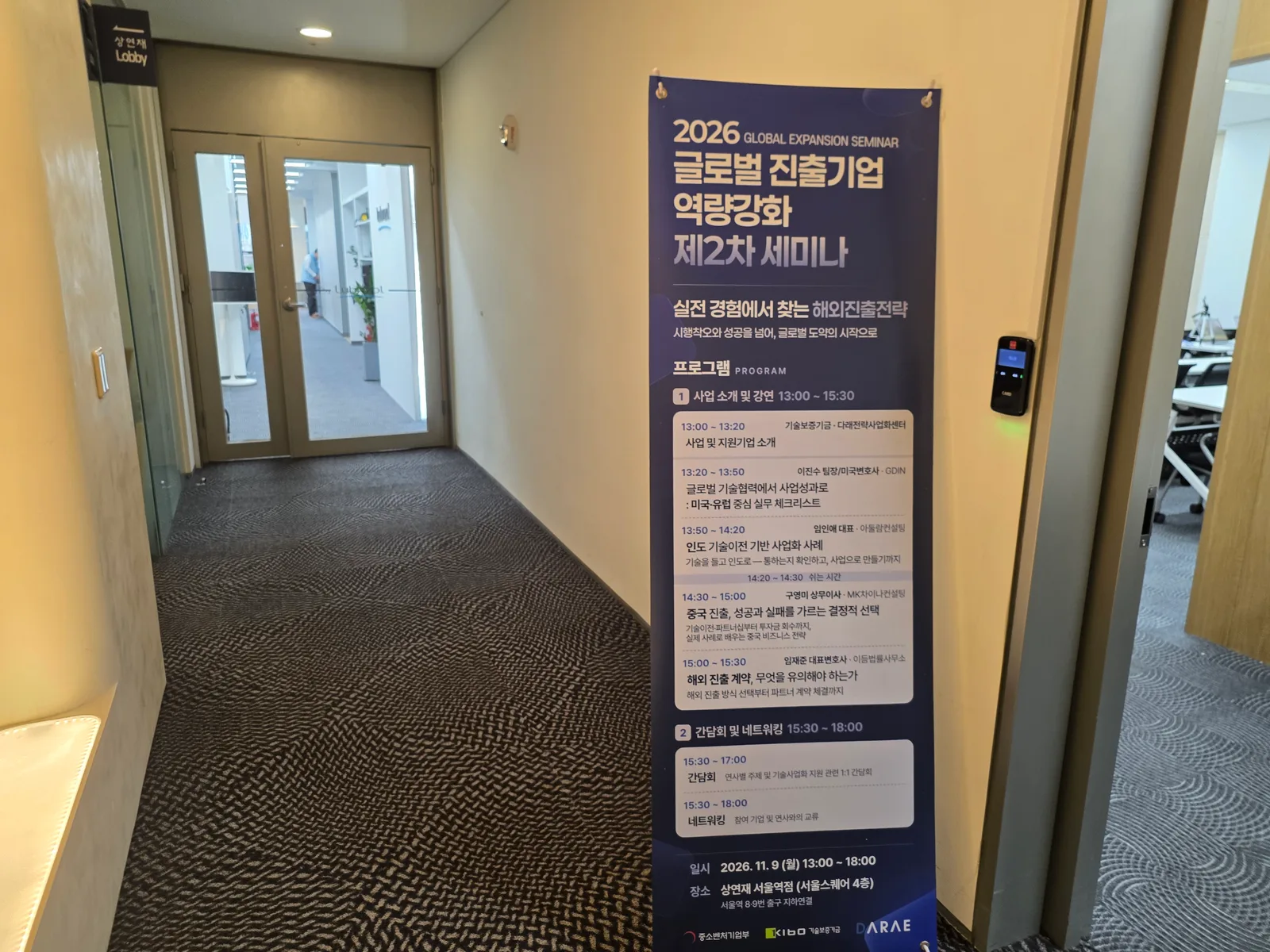
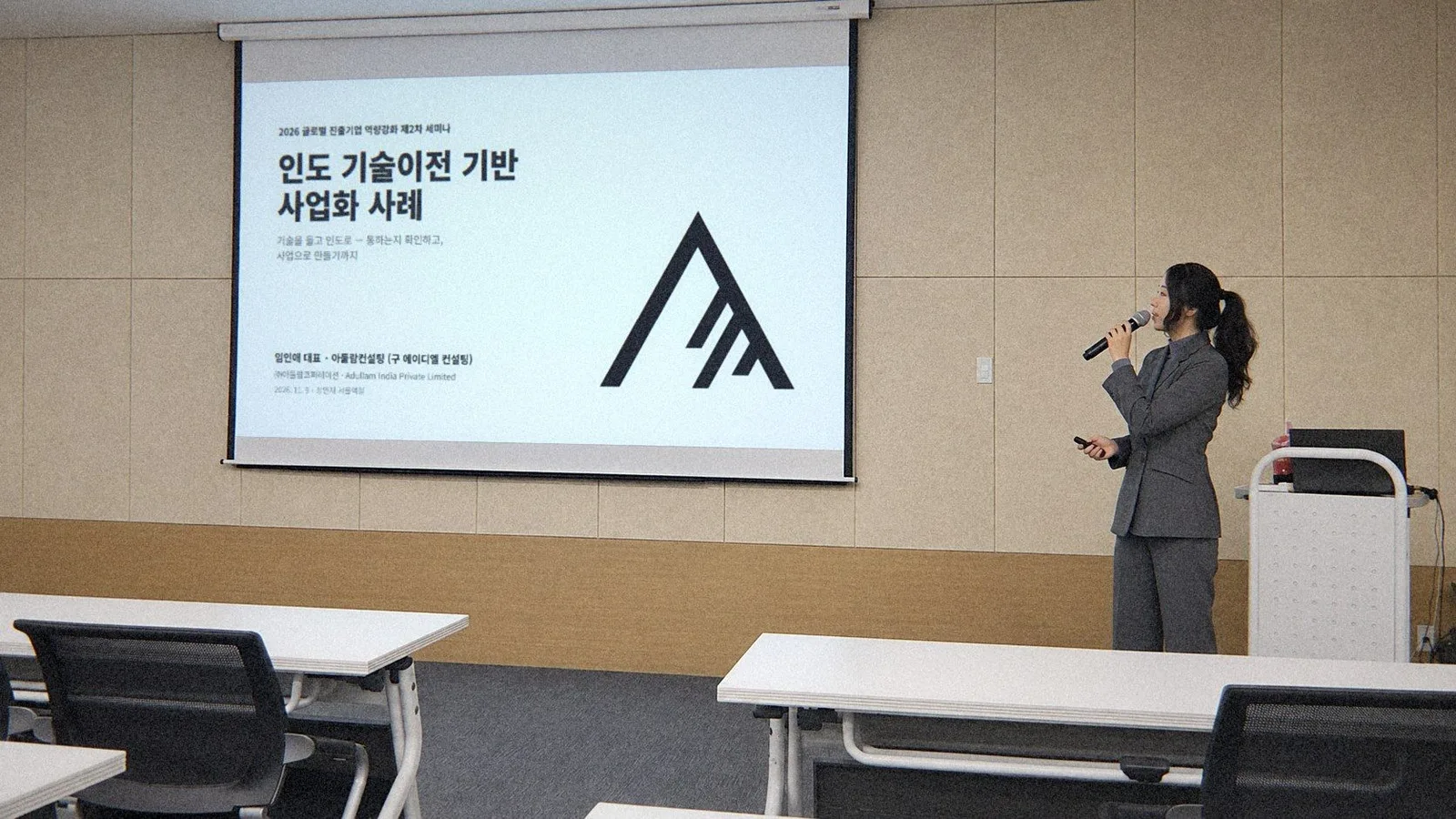
On November 9, 2026, our CEO Inae Lim presented “Technology Transfer–Based Commercialization in India: Case Studies” at the 2nd 2026 Global Expansion Seminar, held at Sangyeonjae Seoul Station (Seoul Square, 4F). Organized by the Ministry of SMEs and Startups and the Korea Technology Finance Corporation (KIBO) and run by Darae Strategic Commercialization Center, the seminar was themed “Global expansion strategies from real-world experience.” Alongside the India session, it featured talks on technology partnerships in the US and Europe, market entry in China, and contract drafting for overseas expansion.
The lecture came down to three points:
India is a market for long-term positioning rather than quick sales.
Before you go, run five checks with public data to see whether your technology will work there.
If it will, three decisions — structure, certification and protection — are what turn technology into a business.
Here is what we covered.
1. India is a market for long-term positioning
Trade tensions and tariffs have made it standard practice to spread production and sales across more than one base. China is still the most complete supply chain and a large market, so most companies keep their existing base and add one more — the “China+1” approach. Mexico, Southeast Asia and India are all being considered as that “+1,” but each has a different profile.
Candidate | Strengths | Considerations |
|---|---|---|
Mexico | Close to the US market and plugged directly into North American supply chains | Far from Korea, so harder to manage |
Southeast Asia (ASEAN) | Established production bases and supply chains | Many early movers, so competition is intense |
India | A growing middle class and domestic demand, plus policies that promote manufacturing | Supply chains are still forming; taxes, labor rules and certification vary by state |
There is no single right answer; it depends on your goal. For near-term revenue, look at Mexico or Southeast Asia. For long-term positioning, look at India.
India is already the world’s third-largest economy in purchasing-power terms. In its October 2026 outlook, the IMF raised India’s growth forecast for 2026 (FY2026-27) to 7.0% and projected that India will become the world’s fourth-largest economy by nominal GDP in 2027. Add to that policies that support local production, such as Make in India and the Production Linked Incentive (PLI) schemes; trust in Korean quality built by Samsung, LG and Hyundai; and demand for technology partners who can help grow Indian manufacturing.
Just as Korea grew by bringing in advanced technology and absorbing it, India is now at that stage. That leaves one question: will your technology work in India?
2. Five checks you can run from your desk
Before you book a flight, public data alone can give you a first answer.
Question | Where to check | Green light |
|---|---|---|
Q1. Is India buying this now? | India’s Ministry of Commerce export-import data (tradestat.commerce.gov.in): import value for your product’s 8-digit Indian HS code over the past 3–5 years, and share by country | Imports are growing, and buyers want to diversify suppliers |
Q2. Can you name three companies that would buy? | Current customers with plants in India and their suppliers, Indian business groups, government procurement (GeM), and KOTRA’s directory of Korean companies overseas | A customer you already serve in Korea is producing in India |
Q3. Will they buy at that price? | Prices of similar products on the B2B platform IndiaMART, GeM transaction prices, and Amazon.in for consumer goods | Your landed cost — cost plus freight, customs duty and IGST — falls within the local price range |
Q4. Can you earn the right to sell? | BIS mandatory certification lists, and CDSCO, FSSAI and EPR requirements | Certification is required but obtainable — and once cleared, it becomes a barrier to others |
Q5. Is the sector backed by policy? | PLI-eligible sectors and state industrial incentives | The product is covered by PLI, localization or import-substitution policies |
Count your green lights to judge your timing.
4–5 — time to go in: there is a good chance it will work within five years. Secure your position first.
3 — time to test small: sell through exports or a partner first, then decide.
2 or fewer — time to watch: prepare, and wait for the market to catch up.
That is as far as desk research can take you. The real answers to Q2 and Q3 — who will buy, and at what price — come only from asking local purchasing managers directly. It also helps to check candidate companies’ registration status and track record in the public records of India’s Ministry of Corporate Affairs (MCA).
3. If it works: three decisions that turn it into a business
Once you have confirmed a fit, three decisions follow: how you will enter (structure), how you will earn the right to sell (certification), and how you will protect your technology and your money (protection).
Decision 1. Structure — how will you enter?
Entry structure | Investment | Control | Technology exposure | Best when |
|---|---|---|---|---|
Exports / local distributor | Low | Low | Low | You want to confirm demand first |
Technology licensing | Low | Low | High | An Indian manufacturer produces and you earn royalties |
Partner / joint venture (JV) | Medium | In line with equity | Medium | A partner can open up customers, sourcing and talent |
Wholly owned company / plant | High | High | Managed directly | Customers require local production and volumes are visible |
Ask three questions before you choose.
Do your customers require local production? If automotive or appliance customers want localization, exports alone will cost you the next project.
How much of your core technology can you hand over? With licensing or a JV, technology passes to the partner. Decide first what to share and what to keep.
How will you exit? The time and cost of a liquidation, a stake sale or the sale of the company are set by the structure you build on the way in.
There is also more than one way to transfer technology. In contract manufacturing, an Indian manufacturer produces to your specifications while you handle sales — a fit when you need local production but want to limit investment. Licensing earns royalties quickly but exposes the most technology, so scope, term and territory must be limited by contract. A JV gives you a say in management in line with your equity, and suits cases where you need the partner’s customers, sourcing and people. These are choices, not right answers, so compare them side by side. Before a full-scale entry, a liaison office (LO) can serve as a base, but it is limited to market research and liaison work, with no sales activity.
If you set up a company, wholly owned and joint-venture companies go through the same four stages.
Structure design: directors and shareholders, registered address, business objects, funding method and amount of investment
Incorporation approvals: name approval, certificate of incorporation, PAN and TAN, Director Identification Numbers (DIN)
Capital deployment and reporting: company bank account, remittance of share capital, bank KYC and FIRC, reporting to the Reserve Bank of India (FC-GPR)
Registrations to start business: GST, Importer-Exporter Code (IEC), Shops & Establishments, PF
Manufacturers also need air and water consents (CTE and CTO), factory plan approval, and factory registration and licensing.
The lecture also shared cases from clients who have agreed to be named. Korea Ginseng Corporation, for example, began with FSSAI and LMPC certification and distribution and marketing consulting, without setting up an Indian company. The way you enter shapes your financing, your permits and how you eventually exit.
Decision 2. Certification — how will you earn the right to sell?
In India, many products cannot clear customs or be sold without certification, and each product needs its own “entry ticket.”
What you sell | Certification / approval | Authority |
|---|---|---|
Electrical and electronic goods, consumer products, materials and components | BIS — CRS registration or ISI certification | Bureau of Indian Standards (BIS) |
Cosmetics, medical devices, pharmaceuticals | CDSCO registration (e.g., COS-2 for cosmetics) | Central Drugs Standard Control Organisation (CDSCO) |
Food | FSSAI license | Food Safety and Standards Authority of India (FSSAI) |
Plastic packaging, electronics, batteries | EPR registration (extended producer responsibility) | Central Pollution Control Board (CPCB) |
Import and sale of packaged goods | LMPC registration (legal metrology and labeling) | Legal metrology authorities |
A local plant in India | Environmental consents (CTE and CTO), factory plan approval and operating license | State government |
Detailed requirements depend on the HS code and intended use.
Across our certification work, delays tend to occur at the same points.
BIS ISI (overseas factories): both a factory audit by a BIS officer and testing at a recognized lab in India are required, and the wait for an audit date is long.
CDSCO (cosmetics and medical devices): notarization and apostille, verification of free sale certificates, and review of ingredients and labels — a single formatting issue can trigger a request for more documents.
Environmental and factory approvals: without the consent to establish (CTE) you cannot start construction, and without the consent to operate (CTO) you cannot start production.
You can start selling locally early, but supply can begin only after certification. Your certification schedule is your revenue schedule. That is why certification lead time belongs at the very front of your business plan. Once you clear it, it becomes a barrier to the competitors who follow.
Decision 3. Protection — how will you protect your technology and money?
Protect your technology before you enter.
Trademarks and patents first: file in India before you become known in the market. You can also designate India through international filings under the Madrid system and the PCT.
Partner due diligence: before signing, check registration records, financials, GST filing history and litigation history. The issuer of a legal due diligence report bears legal responsibility for it.
What to put in the contract: the scope of technology transferred, ownership of improvements, confidentiality, and no use after termination. Contract drafting was covered in detail in the session that followed.
Pave the way for money to come back to Korea, too. Even a successful business can get stuck at the stage of bringing money home.
Royalties and technical fees (India → Korea): tax is withheld in India. To apply the treaty rate you need documents such as a Tax Residency Certificate (TRC), and you claim a foreign tax credit in Korea.
Supply of products and parts (Korea → India): you need to support an arm’s length price for transfer pricing, and related-party imports are subject to customs valuation by the Special Valuation Branch (SVB).
Investment and loans (Korea → India): foreign investment reporting (FC-GPR) and external commercial borrowing (ECB) filings later become the basis for dividends, repayment and repatriation.
Tax rates and forms may change as laws are amended.
Finally, a single Indian company faces dozens of filing, payment and renewal deadlines each year.
Frequency | Main obligations |
|---|---|
Monthly | GST returns and payment, TDS payment, social security contributions (PF and ESIC), state professional tax (PT) |
Quarterly | TDS returns, advance corporate tax |
Annual | Corporate tax return and tax audit, transfer pricing report, annual company filings (AOC-4 and MGT-7), annual GST return (GSTR-9 and 9C), Foreign Liabilities and Assets (FLA) return, director KYC |
As needed | Renewal of certifications and licenses; changes in directors, address or capital; capital increases and borrowings |
Applicability and deadlines depend on company size, industry and state.
A company’s lapse can become a director’s personal liability. If tax deducted at source is not paid over, the officer in charge can face criminal prosecution; GST evasion or wrongful input tax credit above certain thresholds is treated as an arrestable offense; late annual filings can bring daily penalties that extend to directors; and a director designated as the factory occupier is directly liable for accidents and violations. Deadlines should be managed by a system, not by memory. You can also check India’s statutory deadlines in the compliance calendar of Orvano, a free tool built by Adullam.
4. Your checklist
Any box you cannot tick shows where your company is stuck today.
Will it work?
☐ We have checked our product in India’s import data
☐ We can name three companies that would buy
☐ We have compared local price ranges with our costs
Structure
☐ We have confirmed whether customers require local production
☐ We have decided which technology to share and which to keep
☐ We have thought about how we would exit (liquidation or sale)
Certification
☐ We have confirmed the certifications our product needs
☐ We have put certification lead time at the front of our schedule
Protection
☐ We have filed trademarks and patents in India
☐ We have set up how money will come back to Korea
Closing
Entering India starts not with “What should we sell?” but with “Which Indian companies will buy?” Adullam Consulting supports this process through the Adullam Summit Program.
Stage 1 · Free — India Entry Feasibility Diagnosis: complete a short online survey (about 10 minutes) and, within 3 business days, receive a report covering demand in India for your product category, a comparison of entry paths, mandatory certifications and lead times, common reasons for failure, and typical timelines and cost ranges by procedure.
Stage 2 · 3 weeks — Entry strategy design: local research and workshops to map demand structure and buyers, competing suppliers and price positioning, three entry options, regulatory requirements, investment size and time to break-even.
Stage 3 · 6 months and beyond — Dedicated entry execution: a dedicated team of at least one person in Korea and one in India, from sourcing and verifying partners (registration, financials, GST, litigation) to site visits, decision-maker meetings and contract negotiation.
After entry, the same team handles incorporation, tax and accounting, certification, HR, legal, real estate and distribution.
👉 Apply for the free India Entry Feasibility Diagnosis
We thank KIBO and Darae Strategic Commercialization Center for hosting the seminar, our fellow speakers, and all the companies that joined us.
Adullam Consulting is here to help.
References: Electronic Times (etnews), seminar announcement, October 23, 2026 (in Korean) · Qatar Tribune, “India expected to be No 4 economy by 2027, says IMF”