

Hello, this is Adullam Consulting (formerly ADL Consulting).
"We heard that India relaxed its e-commerce rules in July 2026. Does that mean we can now hold stock in India and sell online directly?" It is the question we are asked most often at present by companies looking at e-commerce in India.
There is something you need to establish before answering it: which way the newly opened door faces. The July 2026 exception opens a path for goods made in India to leave the country. The rules on selling to Indian consumers have not moved. Read the direction the wrong way round, and the design of your Indian company will be wrong from the outset.
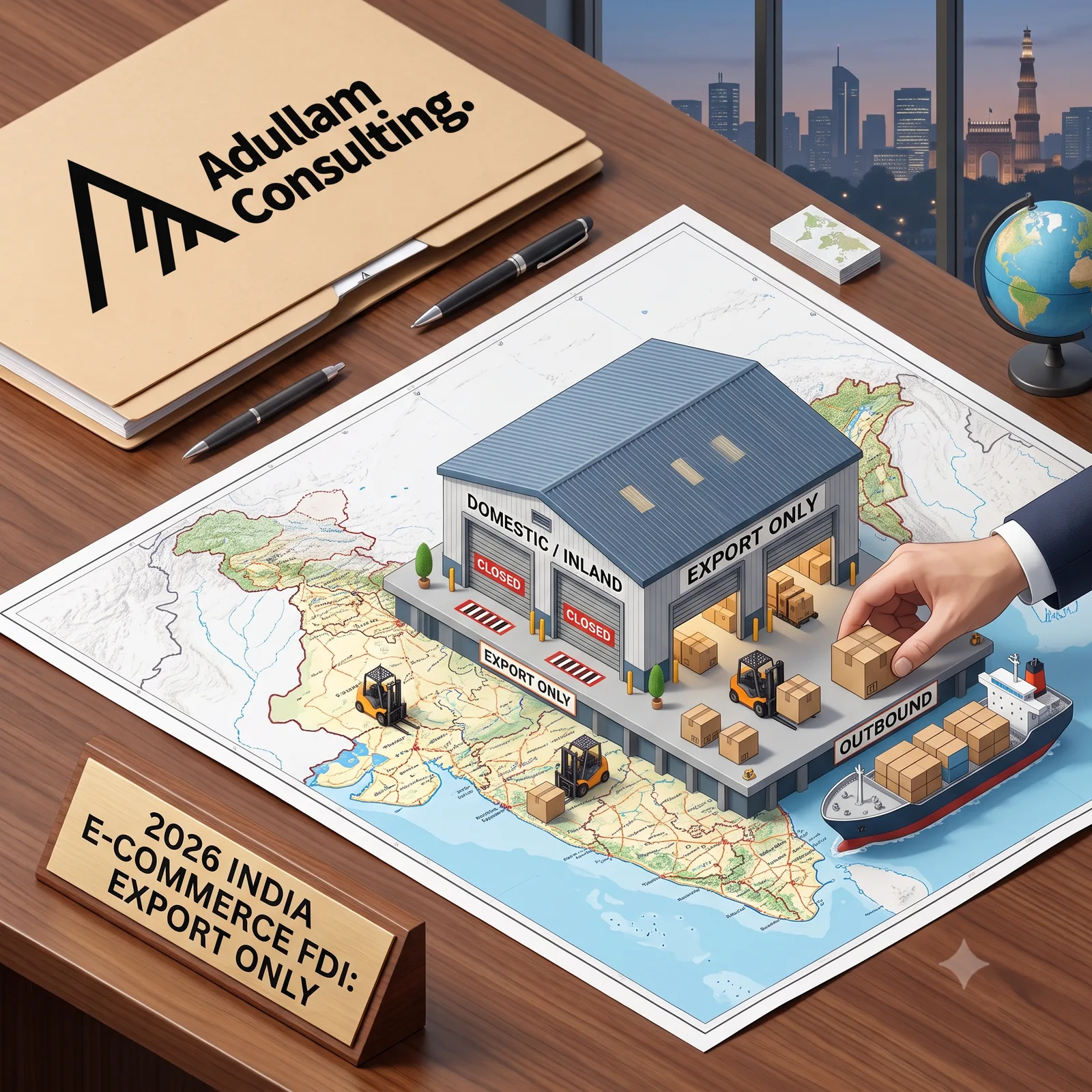
Key Points of This Article
For those of you who are pressed for time, we will begin with the conclusions.
India's e-commerce FDI rules turn on whether the platform owns the stock. The marketplace model is open to 100 per cent foreign ownership under the automatic route; the inventory model cannot receive foreign investment.
Even the open marketplace has two lines drawn through it. A seller holding more than 25 per cent of a platform's sales can make the platform look like the real owner of that stock, and the platform has no say over prices.
The exception of 23 July 2026 opens only inventory held for export. FDI is permitted in the inventory model solely for the export of goods manufactured or produced in India.
It takes effect from the notification of a FEMA rules amendment, not from the announcement. Whether you can actually use it depends on that notification.
For a D2C brand selling to Indian consumers, nothing has changed. Seller status must still sit with an Indian company, and there are still three routes.
1. The Basic Structure of India's E-commerce FDI Rules — Who Owns the Stock
In India, selling online is not a separate regulatory field. It is one layer of the rules on distribution and retail. Because the entry of foreign capital into retail is politically sensitive, the Consolidated FDI Policy and the press notes issued by the Department for Promotion of Industry and Internal Trade (DPIIT) divide e-commerce, too, according to the business model.
The dividing line comes down to a single question: is the platform the owner of the stock, or an intermediary that brings sellers and buyers together?
Marketplace model | Inventory model | |
|---|---|---|
Role of the platform | Connects sellers and buyers | Owns stock and sells it directly |
Owner of the stock | The sellers listed on the platform | The platform |
Foreign investment | 100% · automatic route | Not permitted (save for the July 2026 export exception) |
Where a Korean company fits | Sets up an Indian company that lists as a seller | Cannot operate it for Indian consumers |
The screen a consumer sees may look identical in both cases. What decides whether foreign investment is permitted is whose books the stock sits on. Every judgement that follows starts from this distinction, so it is worth fixing it firmly before any other part of the plan is drawn up. For a Korean brand, the practical consequence is simple: when it sells online to Indian consumers, it does so as a seller on someone else's platform, or through its own Indian company, and never as a foreign-owned platform holding stock for the Indian market.
2. Two Lines Drawn Through the Marketplace — the 25 Per Cent Threshold and the Bar on Price Influence
An open marketplace does not mean that any structure will do. Two lines exist to stop a platform from holding the stock in substance while describing itself as an intermediary.
First, where one seller's sales exceed 25 per cent of everything sold on the platform, the platform can be treated as controlling that seller's inventory. Second, the platform must keep out of pricing altogether: it may not shape the selling price by any direct or indirect means.
Both lines are addressed to the platform, but they reach into the design of any business that lists on it. A contract that channels a large share of your volume through one platform, or a promotion in which the platform effectively sets your price, should be measured against these lines before it is signed. We would suggest keeping the decision on price where it belongs: with your Indian company, as the seller.
3. Press Note No. 3 (2026 Series) of 23 July 2026 — What Has Been Opened
On 23 July 2026 the DPIIT issued Press Note No. 3 (2026 Series). It permits FDI in e-commerce entities that operate the inventory model, which had until then been closed to foreign investment, but confines that permission to the export of goods manufactured or produced in India. Broken down, the exception has four elements.
Element | Content | What to check |
|---|---|---|
Business model | An e-commerce entity that holds inventory | Objects clause · FDI sector classification |
Goods covered | Goods manufactured or produced in India | Goods made outside India are not covered |
Direction of sale | Export | Sales to Indian consumers remain barred |
Effective date | Notification of the amendment to the FEMA (Non-debt Instruments) Rules | The notification date, not the announcement date |
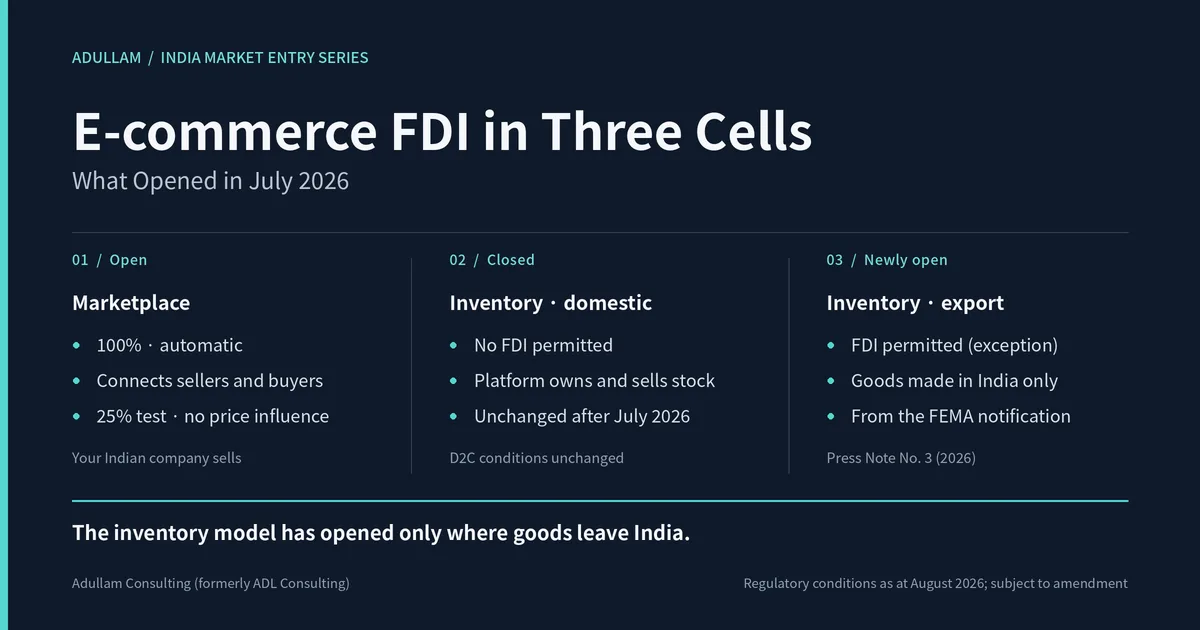
If any one element is missing, you are outside the exception. An inventory model that sells to Indian consumers remains in prohibited territory, and an export of goods made outside India is not covered, however the platform itself is organised. The four elements are cumulative, not alternatives, and it is worth testing a proposed structure against each of them in turn rather than against the headline alone.
4. The Passage That Needs a Careful Reading — Inventory for Export, Not for the Domestic Market
The change can be put in a single sentence. The stock that may now be held is stock on its way out of India; stock to be sold inside India remains off-limits.
The new path is for foreign capital that wishes to use India as a stock hub for cross-border e-commerce exports. If your company already manufactures in India, or sources goods from Indian suppliers, this is a change worth examining: goods produced in India could be held in Indian warehouses and sold online to customers abroad.
For a D2C brand that wishes to sell directly to Indian consumers, by contrast, the landscape is exactly as it was. If you design a company to hold stock for the domestic market on the strength of a headline saying that "e-commerce has been liberalised", that structure will sit outside the rules from the day it is created. The press coverage of a change of this kind tends to report that something has opened; it rarely says in which direction, and for a foreign investor the direction is the whole point.
The timing also needs separate attention. The exception cannot be used from the day the press note was issued. It takes effect from the date on which the corresponding amendment to the Foreign Exchange Management (Non-debt Instruments) Rules is notified.
※ Please note — this article is based on publicly available material as at August 2026. At the time of your review, you should re-confirm whether the amendment to the Non-debt Instruments Rules has been notified, and check the DPIIT's latest press notes.
5. Selling Online to Indian Consumers — Still Three Routes
After July 2026, as before, there are three routes by which a Korean brand can reach Indian consumers online, and on every one of them seller status sits with an Indian company.
Route | What it looks like online | Conditions that come with it |
|---|---|---|
Marketplace listing | Your Indian company opens a seller account on the platform | The platform's 25% threshold · bar on price influence |
Single-brand retail (SBRT) company | May begin selling online before opening a store | A store within 2 years of going online · above 51% foreign shareholding, 30% local sourcing |
Wholesale company + Indian distributors | Your Indian company supplies businesses only; sales to consumers are left to Indian distributors | Sales to businesses only · group sales capped at 25% of turnover |
The point to watch is the online-first option for single-brand retail. Since the 2019 amendment (Press Note 4 of 2019), you may go online before you open a store, but a two-year clock starts on the day you do. If your plan is to gauge the online response before deciding on stores, you should first establish whether site selection and the lease can be completed within those two years. Planning backwards from the deadline, rather than forwards from the launch, is the safer way to read this rule.
6. If You Are Considering the Export Exception — Three Things to Have in Place First
If you are thinking about a business that fits the exception, the foundations of an exporting business come before the design of any platform.
First, goods made in India. Since the exception covers only goods manufactured or produced in India, a manufacturing base or an Indian source of supply must already be part of the plan. The starting point is the production structure, not the sales channel.
Second, an Importer-Exporter Code (IEC). To export goods from India you need an IEC issued by the Directorate General of Foreign Trade (DGFT). Obtaining one is not difficult, but it must be updated every year even when nothing has changed; miss the update and the code is deactivated, and clearance stops at the port. The annual step is most often lost when the person responsible changes or the accounting firm is replaced, so it belongs in the company's compliance calendar rather than in one individual's memory.
Third, your sector classification and your objects. When an activity moves from trading to retail, or from services to manufacturing, the FDI caps and conditions that apply change with it. If you intend to add an inventory-based export business to an existing Indian company, begin by checking whether the objects clause and the registered particulars cover the new activity.
7. The Tax Consequences of Selling Online — Fulfilment Centres and GST Registration
Selling online can look like a business that lives on a screen, but tax follows the ground on which the goods are kept. Since GST 2.0 took effect on 22 September 2025, the rate structure has consisted of two standard rates, 5 and 18 per cent, and a special rate of 40 per cent. Registration and filing, unlike the rates, are still handled state by state.
If you spread your stock across a platform's fulfilment centres in several states, each of those addresses has to be registered as an additional place of business of your company, and each state brings its own GST registration number (GSTIN) and its own set of returns. Goods moving across a state border also need an e-Way Bill. A decision taken to shorten delivery times is therefore also a decision to add filing obligations, and we would suggest that the finance team works out the placement of fulfilment centres together with the logistics team. Left to the logistics team alone, the calculation will optimise freight and transit times and is likely to leave the cost of the additional registrations out of the picture.
Frequently Asked Questions (FAQ)
Q1. Does the exception mean that we can now hold stock in India and sell directly to Indian consumers?
No. The exception is confined to the export of goods manufactured or produced in India. As at August 2026, foreign investment is still not permitted in an inventory model that sells to Indian consumers.
Q2. The press note has been issued. Can we go ahead and design the company now?
You can begin reviewing the design, but the exception takes effect only from the date on which the amendment to the FEMA (Non-debt Instruments) Rules is notified. We would suggest confirming the notification and its wording before you fix the timetable for the investment itself.
Q3. If we hold goods made in Korea in an Indian warehouse and sell them to customers in third countries, are we covered by the exception?
The exception covers goods manufactured or produced in India. A structure in which goods made outside India pass through an Indian warehouse on their way out is difficult to bring within its wording, so we would suggest examining any specific structure against the text of the amendment once it is notified.
Q4. If we list on a marketplace, may we agree our selling prices with the platform?
Pricing is outside the platform's reach: it may not affect your selling price by any direct or indirect means. It is usual for the price to be set by your Indian company as the seller, and we would suggest checking that any promotional terms you negotiate are consistent with that principle.
In Closing
The change of July 2026 did not throw open the door to Indian e-commerce. It is closer to opening a single window on the export side. For companies that produce in India it is new material for designing a route to customers abroad; for brands aiming at Indian consumers it is confirmation that nothing has changed.
That is why the order matters. Decide what you will sell and where; settle the sector classification and the objects to match; confirm that the notification has been made; and only then commit the investment. Skip that order on the strength of a single news headline, and the first thing you will have built is a company structure that is hard to undo.
In the next article we will look at something that should be finished before you settle on any sales route: when to file your trade mark in India.
📘 If You Would Like to Go Deeper into This Subject
The seven items that must be redesigned when your purpose changes — the objects clause, FDI classification, GST registration, bonded schemes, transfer pricing, workforce and contracts, checked in a single table
The two points at which exporting companies come to grief over paperwork — the annual IEC update and post-clearance verification of CEPA origin
SEZ, EOU and MOOWR compared — choosing a bonded scheme when you intend both to export and to sell domestically
In what order to build sourcing, domestic sales and manufacturing — three paths of evolution for a company with more than one purpose
📗 India Incorporation and Foreign Direct Investment (FDI) Regulation, the first volume of The Real Rules of Entering India, is available from BOOKK.
![[India Entry Guide] India's E-commerce FDI Rules and the Exception Opened in 2026 1](/uploads/412f7daaac9f2d44.webp)
If You Are Unsure Where to Begin with Your Entry into India
Adullam Consulting established its Indian subsidiary in Delhi in 2017 and now works from four offices — Delhi, Bengaluru, Chennai and Seoul. We have advised more than 100 companies and handled more than 300 licensing and government-facing matters.
Incorporation, tax and accounting, certification and incentives, human resources and legal, real estate, and distribution and marketing: six areas supported by a single team. Adullam Consulting will be with you as a dependable partner in your entry into the Indian market.