

Hello, this is Adullam Consulting (formerly ADL Consulting).
"We would like to sell our brand in India. Which distributor should we be working with?" It is the first question we hear from companies preparing for domestic sales in India. Almost as often, we are asked whether it would not be simpler to list on one of the local online marketplaces and start selling straight away.
There is something you need to establish before either question. In India, the way you sell determines how much of the business a foreign investor may own, and which conditions come with that ownership. The India retail FDI rules divide distribution into four layers. Choose the wrong layer, and the problem is not that sales are slow to build: it is that the way you are selling sits outside what the rules permit.

Key Points of This Article
For those of you who are pressed for time, we will begin with the conclusions.
In India, a shop is generally harder to open than a factory. Most manufacturing is open to 100 per cent foreign ownership under the automatic route, whereas distribution and retail are governed by finely drawn rules that depend on how you sell.
Distribution FDI is divided into four layers. Wholesale, single-brand retail (SBRT), multi-brand retail (MBRT) and e-commerce each carry their own cap on foreign shareholding and their own conditions.
Multi-brand retail is open on paper but closed in practice. It requires the consent of the state government concerned, and many states have not given it.
A Korean brand has, in effect, three routes to the Indian consumer. A single-brand retail company, a wholesale company working with Indian distributors, or a listing on a marketplace.
The route must be chosen when the company is designed. GST registrations, pricing and the timing of your trade mark application all follow from that choice.
1. Why India's Retail FDI Rules Are So Tightly Drawn — A Country Where Shops Are Harder Than Factories
Many senior managers assume that selling goods must be easier than building a factory. In India it is generally the other way round. In most sectors, a factory can be established with 100 per cent foreign ownership under the automatic route, without prior approval. Distribution and retail, by contrast, are politically sensitive, and FDI policy has accordingly divided them into finely drawn rules according to how, and to whom, the goods are sold.
Those rules are found in the Consolidated FDI Policy and in the press notes issued from time to time by the Department for Promotion of Industry and Internal Trade (DPIIT). This is why a company whose purpose is domestic sales needs to check the cap on foreign shareholding before it chooses the form of entity. For most purposes of entry, the form is the first decision. For domestic sales, the layer in which you will sell comes first, because it settles how much of the company a foreign investor may hold; the form of entity then follows from it.
2. The Four Layers of Distribution FDI at a Glance — Wholesale, Single-Brand, Multi-Brand and E-commerce
The four layers can be set out in a single table.
Layer | Foreign shareholding · route | Key conditions |
|---|---|---|
Wholesale / cash and carry | 100% · automatic | Sales to businesses only. Sales to group companies capped at 25% of total turnover |
Single-brand retail (SBRT) | 100% · automatic | Above 51% foreign shareholding, 30% of procurement must be sourced in India |
Multi-brand retail (MBRT) | Up to 51% · government approval | Minimum investment of US$100 million, consent of the state government and other conditions |
E-commerce | 100% · automatic (marketplace model only) | No FDI in a model where the platform holds the inventory |
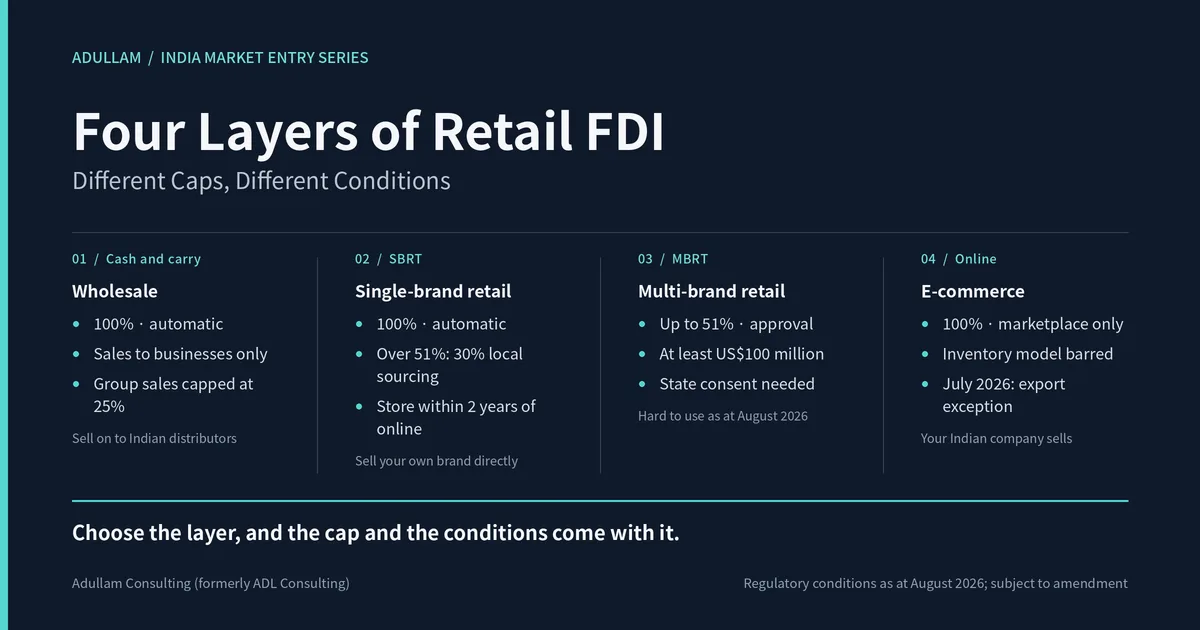
Read the table quickly and three of the four layers appear to be open at 100 per cent. Behind each of those figures, however, sit conditions: on whom you may sell to, on what you must buy and where, and on who may hold the stock. It is in those conditions, not in the headline percentage, that the real decision is made. The sections that follow take the layers one at a time, beginning with the one most Korean brands look at first.
3. Single-Brand Retail (SBRT) — The Conditions That Follow Even When 100 Per Cent Is Open
Single-brand retail, in which a company sells products under its own single brand, is open to 100 per cent foreign ownership under the automatic route. The conditions attach the moment foreign shareholding exceeds 51 per cent. From that point, 30 per cent of procurement must be sourced within India — measured as an average over the first five years, and year by year thereafter.
There is also a rule about the order in which you may sell. Since the 2019 amendment (Press Note 4 of 2019), a single-brand retailer may begin selling online before it opens a physical store. It must, however, open a physical store within two years of starting online sales. If your plan is to test the market online first, those two years become the deadline for your store-opening programme, and the store search, the lease and the fit-out all need to be planned backwards from it.
4. Wholesale and Multi-Brand Retail — One Door Open Only to Businesses, One Held Shut by Its Conditions
Wholesale, including cash and carry wholesale trading, is open to 100 per cent foreign ownership under the automatic route. In return, sales are confined to businesses, and sales to group companies may not exceed 25 per cent of total turnover. It is not a route for selling directly to Indian consumers. It is the form that suits a structure in which your company sells to Indian distributors and leaves the retail stage to them.
Multi-brand retail, in which several brands are sold under one roof, sits behind a very different threshold.
Multi-brand retail condition | Requirement |
|---|---|
Shareholding · route | Up to 51% · government approval |
Minimum investment | Foreign investment of at least US$100 million, of which at least 50% must go into back-end infrastructure within three years |
Local sourcing | 30% of procurement from Indian small and medium enterprises |
Store locations | Cities with a population of one million or more |
State government | Consent of the state government concerned |
The decisive line is the last one. A considerable number of states have not given that consent, and as at August 2026 it is difficult to regard multi-brand retail as a route that can actually be used. The door exists in the rules, but it is not one on which a business plan can safely rely. For a Korean brand planning its first entry, it is more prudent to treat multi-brand retail as closed, and to revisit it only if the policy changes.
5. E-commerce — The Marketplace Is Open; the Inventory Model Is Not
In e-commerce, 100 per cent foreign ownership under the automatic route is available only to the marketplace model, in which the platform does no more than connect sellers and buyers. The inventory model, in which the platform itself holds stock and sells it directly, cannot receive foreign investment.
Two further conditions keep the marketplace honest. If a single seller accounts for more than 25 per cent of a platform's total sales, the platform may be regarded as controlling the inventory. And the platform may not influence the selling price, whether directly or indirectly.
On 23 July 2026 the DPIIT opened an exception for the inventory model in Press Note No. 3 (2026 Series). It is confined, however, to the export of goods manufactured or produced in India, and it takes effect only from the date on which the corresponding amendment to the Foreign Exchange Management (Non-debt Instruments) Rules is notified. The change needs to be read precisely. What has been opened is the holding of inventory for export, not the holding of inventory for the domestic market. Foreign capital that wishes to use India as a stock hub for cross-border e-commerce exports has a new path; for a D2C brand that wishes to sell directly to Indian consumers, the conditions are unchanged.
※ Please note — FDI conditions for distribution and e-commerce are amended frequently by press note. You should re-confirm them against the DPIIT's latest notification at the time of your review.
6. Three Routes Open to a Korean Brand — and What Each One Brings with It
Taken together, as at August 2026 a Korean brand has, in effect, three routes to the Indian consumer.
Route | Structure | What it settles |
|---|---|---|
Single-brand retail company | Your Indian company sells your own brand directly | Local sourcing condition · deadline for opening a store |
Wholesale company + Indian distributors | Your Indian company sells to businesses; Indian capital handles retail | Sales to businesses only · cap on group sales |
Marketplace listing | Your Indian company lists on a platform as the seller | Platform rules on inventory and pricing |
Which of these to choose may look like a marketing decision about sales channels. In reality it is a regulatory question that has to be settled together with the company's shareholding and its objects. A company that starts as a wholesaler and later moves into retail finds that the applicable caps and conditions change, and the shareholding structure it has already put in place may itself fall foul of the rules. The choice is therefore one for the board, taken together with the advisers who will design the company, rather than one to be left to the team that will later run the channel.
7. What Follows Immediately Once the Route Is Chosen — GST Registration, Pricing and Your Trade Mark
Once the route is fixed, three things follow straight away.
First, GST registration. The so-called GST 2.0, in force since 22 September 2025, simplified the rates into two standard rates of 5 and 18 per cent plus a special rate of 40 per cent. Registration and returns, however, are still organised state by state. A separate GST registration number (GSTIN) is required in every state where you hold stock, and if you use a marketplace's fulfilment centre, that address must also be registered as an additional place of business of your company. Every movement of goods across a state border needs an e-Way Bill. Where you put your warehouses therefore determines the size of your filing burden, and a logistics network designed by the logistics team alone will almost certainly leave that burden out of the calculation.
Second, pricing. If you start from your price in Korea and add customs duty, logistics costs and your target margin in turn, the resulting Indian consumer price usually lands at the very top of the market — a position already occupied by global brands. India is not one market in price any more than it is in geography: within the same category, the entry, mass and premium price bands are separate markets, with different consumers, distribution channels and service expectations. We would suggest working the other way round. Fix the consumer price for the segment you are targeting first, deduct the distribution margin, GST, logistics and customs duty to arrive at the ex-factory cost you can afford, and then redesign the specification and the local sourcing ratio to meet that cost.
Third, your trade mark. Your application should be completed before you meet any prospective distribution partner or dealer. India's Trade Marks Act, 1999 recognises the rights of a prior user, but proving them is slow, expensive and uncertain, and in practice the first to file holds a decisive advantage. The cost and time involved in buying back a mark that a local party has filed first, or in contesting it through cancellation proceedings, run to tens or even hundreds of times the cost of filing in advance.
Frequently Asked Questions (FAQ)
Q1. Could our head office in Korea not simply list on an Indian online marketplace and sell directly?
Where you are selling to Indian consumers, the usual structure is for an Indian company to hold the seller status and list on the marketplace. If you plan to concentrate your sales on a single platform, we would suggest checking the 25 per cent threshold described above in advance.
Q2. If foreign shareholding in a single-brand retail company is kept at 51 per cent or below, does the local sourcing condition fall away?
The 30 per cent local sourcing condition attaches when foreign shareholding exceeds 51 per cent. Lowering your shareholding, however, means that the remainder passes into Indian hands, so the question becomes which you would rather concede: the sourcing obligation or management control.
Q3. Will multi-brand retail remain difficult?
On paper, it is open to foreign shareholding of up to 51 per cent with government approval. In addition to the conditions on investment, sourcing and store locations, however, it requires the consent of the state government, and many states have not given it. As at August 2026 it is difficult to regard it as a practical route.
Q4. Could we not start as a wholesale company and switch to retail later?
When activity moves from wholesale to retail, the FDI caps and conditions that apply change, and the objects clause and the GST registration structure need to change with them. We would suggest that, when you first design the company, you sketch out how you expect to be selling several years ahead.
In Closing
What you sell in India, and how you sell it, is a question that belongs in the design of your company before it appears in any marketing plan. The moment you decide which layer of distribution FDI you will stand in, the cap on foreign shareholding, the sourcing obligations, the customers you may sell to and the ways in which you may hold stock are all settled together.
If the order is reversed, you will find yourself unwinding a company and contracts you have already put in place. We would suggest deciding which layer you will sell in, and completing your trade mark application, before you meet any distributor.
In the next article we will take e-commerce on its own and look at what the export inventory exception opened in July 2026 changes — and what it does not.
📘 If You Would Like to Go Deeper into This Subject
The full table of FDI caps and approval routes by sector — distribution and retail set alongside every other sector
Why the day a press note is issued is not the day you can use it — how India's FDI rules are built up in layers
When an investment by your Indian subsidiary in another company also counts as FDI — the rules on indirect investment
The design sequence of a domestic sales company that started from the target consumer price — a case study running through to trade marks, warehouses and product specifications
📗 India Incorporation and Foreign Direct Investment (FDI) Regulation, the first volume of The Real Rules of Entering India, is available from BOOKK.
https://bookk.co.kr/bookStore/6a86df65b1468f4a36f5a612
If You Are Unsure Where to Begin with Your Entry into India
Adullam Consulting established its Indian subsidiary in Delhi in 2017 and now works from four offices — Delhi, Bengaluru, Chennai and Seoul. We have advised more than 100 companies and handled more than 300 licensing and government-facing matters.
Incorporation, tax and accounting, certification and incentives, human resources and legal, real estate, and distribution and marketing: six areas supported by a single team. Adullam Consulting will be with you as a dependable partner in your entry into the Indian market.