

Hello, this is Adullam Consulting (formerly ADL Consulting).
"Would you be able to look over our plan for entering India?" It is the request we receive more often than any other. Plans that describe themselves as an India entry strategy tend to share a shape. They open with a population of 1.4 billion and growth in the region of 6 per cent, and they close with a timetable for incorporation and an investment figure.
What is missing is the part in between: what the company is actually going to do in India. Domestic sales, manufacturing, sourcing and export, and R&D all travel under the same name of "entering India", yet they are different businesses, with different rules, different states that suit them, and different ways of consuming capital. The first question for a board is therefore not "Should we go to India?" but "What are we going to do there?"

Key Points of This Article
For those of you who are pressed for time, we will begin with the conclusions.
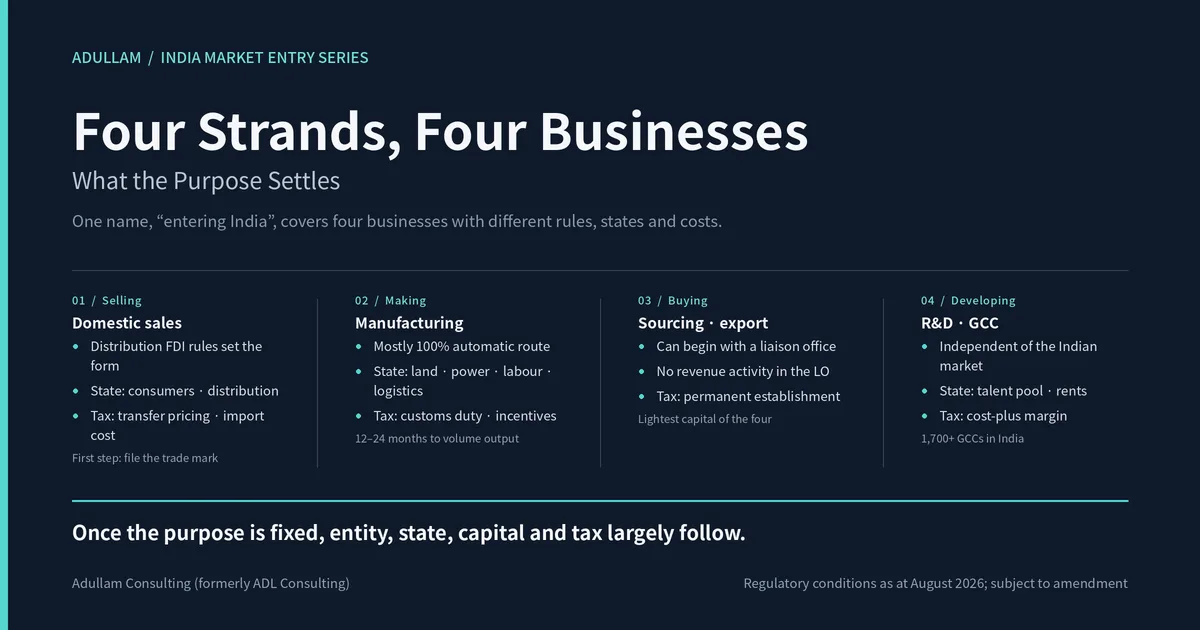
There is no single "India entry strategy". Domestic sales, manufacturing, sourcing and export, and R&D are four separate businesses.
The purpose settles four decisions. The form of entity, the choice of state, the capital structure and the tax design all follow from it.
In India, selling is more tightly regulated than making. Most manufacturing is open to 100 per cent foreign ownership under the automatic route; distribution and retail are divided into layers.
Initial capital requirements differ by a factor of ten or more, depending on purpose. Manufacturing is the heaviest and sourcing the lightest.
If you intend to pursue several purposes, what you must decide is the order. What you do first shapes the structure for everything that follows.
1. Why There Is No Single India Entry Strategy — Four Businesses Under One Name
The four strands differ from the starting line. The foreign direct investment (FDI) rules that apply are different, the states in which it makes sense to locate are different, and so is the objective that the tax design is meant to serve. A metropolitan base that is entirely sensible for a domestic sales company is an unnecessary fixed cost for a sourcing office. The industrial electricity tariff that can make or break a manufacturer's margin is a figure an R&D centre will scarcely notice. The same question has a different right answer for each purpose.
This is why "let us go out first and see" is a risky sentence. Practical as it sounds, in India it amounts to saying that you will take decisions that are hard to reverse before deciding what they are for. The form of entity, the state, the shareholding structure and the objects clause in the company's constitutional documents are all items that, once set, can be changed only by obtaining approvals afresh or by accepting a tax cost.
None of these is a decision that anyone sets out to get wrong. They go wrong because they are taken one at a time, by whoever happens to be handling each of them, with no common reference point against which to test them.
2. Four Decisions That the Purpose Settles — Entity, State, Capital and Tax
The purpose of entry is not a line in a vision statement. It is the reference point from which four practical decisions are taken.
Decision | What changes with the purpose |
|---|---|
Form of entity | Whether a liaison office (LO) is enough, a private limited company (Pvt Ltd) is needed, or a joint venture is unavoidable. Where FDI caps apply, the cap on foreign shareholding is settled before the form |
Choice of state | Manufacturing is governed by land, power, labour and logistics; domestic sales by the consumer market and the density of distribution; R&D by the talent pool and rents |
Capital structure | Paid-up capital, plans for further issues, and the balance between parent company loans and equity. The gap between manufacturing and sourcing exceeds a factor of ten |
Tax design | For domestic sales, transfer pricing and the cost of imports; for manufacturing, customs duty and incentives; for sourcing, permanent establishment (PE); for R&D, the cost-plus margin |
Once the purpose is fixed, the four decisions largely follow. Without it, each is taken by a different department on a different logic, and what remains is a structure at odds with itself.
We have seen a company whose principal purpose was domestic sales place its production inside an export-oriented scheme on the advice that "there are export incentives to be had", only to find itself paying customs duty again every time it sold into the Indian market. Each decision was plausible on its own. There was simply no purpose to hold them together.
3. Domestic Sales and Manufacturing — Selling Is More Tightly Drawn Than Making
Many senior managers assume that selling goods is easier than building a factory. In India it is generally the other way round. In most sectors, manufacturing is open to 100 per cent foreign ownership under the automatic route. Distribution and retail, by contrast, are divided by the Consolidated FDI Policy and the press notes of the Department for Promotion of Industry and Internal Trade (DPIIT) into wholesale, single-brand retail, multi-brand retail and e-commerce, each with its own conditions.
In single-brand retail, foreign shareholding above 51 per cent brings an obligation to source 30 per cent of procurement within India. In e-commerce, FDI is not permitted in a model where the platform owns inventory and sells it directly, and the exception opened in July 2026 is confined to the export of goods made in India. Choose the wrong model here and the consequence is not weak sales: the business model itself falls outside the rules. That is why the first practical step for a domestic sales entry is a trade mark application, completed before you meet any prospective distribution partner.
For a manufacturing base, the order of questions matters. Before asking which incentives are available, you should look at the customs duty structure, because that is the primary variable and incentives sit on top of it. Duty on finished goods is set high and duty on components low, and for certain products the government announces in advance a timetable for localising components and raises duty in that sequence (the Phased Manufacturing Programme, PMP). A business plan for manufacturing should therefore be written against the announced schedule of duty increases rather than against today's rates.
Two further points belong in any manufacturing plan. The 15 per cent concessional tax rate for new manufacturing companies lapsed on 31 March 2024, so a plan that still assumes it needs its basis checked. And even on a standard plot within an industrial park, it is realistic to allow 12 to 24 months from groundbreaking to volume production.
※ Please note — FDI conditions for distribution and e-commerce, and the localisation timetables for individual products, are amended frequently. You should re-confirm them against the latest notification at the time of your review.
4. Sourcing, Export and R&D — Light on Capital, but Not on Design
Sourcing carries the smallest initial capital requirement of the four, which is why so many companies start there — and, for the same reason, why design is so often skipped.
A liaison office opened with the approval of the Reserve Bank of India (RBI) may undertake four activities only: representing the parent, promoting exports and imports, promoting technical and financial collaboration, and acting as a channel of communication. Revenue-generating activity is prohibited, and running costs must be met entirely from remittances from abroad. Identifying vendors and inspecting quality fall within those limits. The moment the office places orders, pays suppliers or appears on documents as the exporter, it is engaged in commercial activity, and the risk of being taxed as a permanent establishment arises. Nor is there any procedure for "converting" a liaison office into a company: incorporating the company and closing the office are two separate pieces of work.
R&D is the purpose Korean companies think of last, yet over the past decade it has been the fastest-growing form of entry into India. The Government of India's Economic Survey 2024-25 counted more than 1,700 Global Capability Centres (GCCs) employing more than 1.9 million people. It is the only one of the four strands that stands independently of the Indian market: you can establish a company in India to employ Indian engineers without selling or making anything there.
The contest is decided not by capital but by three things: transfer pricing on the cost-plus margin, the ownership of the intellectual property (IP) the centre produces, and whether you can keep your people.
5. The Same Years, Two Different Outcomes — Deciding the Purpose First, and Deciding It Later
A mid-sized manufacturer of industrial components set out in 2019 under an instruction from the top: "Look at India." No purpose was defined. The staff seconded to its liaison office in the Delhi capital region drifted naturally into selling, and the company it later incorporated in some haste had objects confined to import and trading.
A year after that, a major customer asked for local production, and the customer's plant was near Chennai. The company had to redesign its corporate structure and tax registrations, and to deal with the possibility that the selling done by its liaison office might be treated as a permanent establishment.
Over the same period, a consumer goods company spent six months doing nothing but settling its purpose before it began. The conclusion was a single sentence: "Within three years, secure sales of our own brand in the Indian domestic market." The entity design, the trade mark application, and the warehouses and GST registrations all followed from that sentence in turn.
Item | The company that decided later | The company that decided first |
|---|---|---|
Starting point | An instruction to "look at India" | Six months spent settling the purpose |
Structure | Liaison office → trading company → redesign for a southern base | Single-brand retail entity · trade mark filed first · GST registrations based on the states of sale |
Outcome | Five years, and more than three times the cost originally planned | Break-even within 18 months |
The difference was not how well either company knew India. It was whether it had decided first what it was going there to do.
6. If You Intend to Pursue Several Purposes — What You Must Decide Is the Order
Real entries do not divide neatly into one strand. Companies source while they sell, and find themselves manufacturing while they sell. That is why the answer "we will do all four" comes up so often. What needs deciding, however, is what to do first. We would suggest placing first the purpose that costs least to learn from, and the form that least narrows the options for the purposes still to come.
When the purpose changes, the objects clause, the FDI approval route, the GST registrations and the transfer pricing policy all need to be redesigned together. Put it off, and the new purpose runs on the old structure; the mismatch tends to surface some years later, at a tax audit or the renewal of a licence. A change of purpose is therefore not an expansion of the business but a change to its structure, and it deserves the same scrutiny as the original entry.
Frequently Asked Questions (FAQ)
Q1. We have not yet settled on a single purpose. Why not open a liaison office first and see?
A liaison office is a good way to learn the market. But because only four activities are permitted, it becomes a liability the moment selling begins. We would suggest deciding, before you open it, exactly how far it will go.
Q2. Our purpose is domestic sales. Could we not take export incentives as well?
In some cases you can. But if production is placed inside an export-oriented scheme for the sake of an incentive, you may end up paying customs duty again every time you sell in India. It is usual to add an incentive only where it fits the purpose.
Q3. Do we need an Indian company merely to set up an R&D centre?
To employ Indian engineers directly, the usual structure is a private limited company wholly owned by the parent, providing services to it. The cost-plus margin and the ownership of IP then need to agree across the service agreement, the employment terms and the transfer pricing.
Q4. How can we tell whether our purpose has really been decided?
The quickest test is to ask your senior management, your country head and your finance lead the same question: "What is the first priority of our Indian company right now?" If you receive three different answers, the structure has very probably divided three ways already.
In Closing
Deciding the purpose is not a matter of choosing what you would like to do; it is a matter of settling what you will not do. If you choose domestic sales, you must resist the temptation to bend the structure in pursuit of export incentives. If you choose manufacturing, you must be wary of improvising a distribution structure for the sake of early revenue.
And the sentence that states your purpose must exist before you choose the form of entity or the state. If the order is reversed, it is the structure you have already built that ends up deciding your purpose.
In the next article we will take the first of the four strands, domestic sales, and look at how FDI rules divide distribution and retail into four layers.
📘 If You Would Like to Go Deeper into This Subject
A strategy matrix by purpose — recommended entry forms and regulatory gateways across all four purposes, on one page
Building the localisation timetable into your business plan — a table recording the localisation date for each item in the bill of materials
The three documents that secure IP at an R&D centre — keeping the service agreement, employment terms and transfer pricing consistent
Seven items to redesign when the purpose changes — from the objects clause to the contracts between parent and subsidiary
📗 India Incorporation and Foreign Direct Investment (FDI) Regulation, the first volume of The Real Rules of Entering India, is available from BOOKK.
https://bookk.co.kr/bookStore/6a86df65b1468f4a36f5a612
If You Are Unsure Where to Begin with Your Entry into India
Adullam Consulting established its Indian subsidiary in Delhi in 2017 and now works from four offices — Delhi, Bengaluru, Chennai and Seoul. We have advised more than 100 companies and handled more than 300 licensing and government-facing matters.
Incorporation, tax and accounting, certification and incentives, human resources and legal, real estate, and distribution and marketing: six areas supported by a single team. Adullam Consulting will be with you as a dependable partner in your entry into the Indian market.