

Summary in three lines ① For Korean companies entering India, the Private Limited Company is effectively the standard vehicle. It permits 100% sole ownership, and legal risk is kept separate from the head office. ② Incorporation itself is completed in four to six weeks through the integrated SPICe+ application on the MCA V3 portal. The real risk lies in the filing obligations that must be dealt with within 180 days after incorporation — FC-GPR, INC-20A, ADT-1 and others. ③ In 2026, a number of substantial changes took effect at once: a complete overhaul of the income tax law (the new Income-tax Act, 2025 came into force), the decommissioning of the MCA V2 portal, the easing of FDI restrictions for land-bordering countries (Press Note 2 of 2026), the restructuring of GST rates, and the shift of director KYC to a three-year cycle. |
Hello, this is ADL Consulting.
Many companies decide to enter the Indian market but then find themselves stuck on the very first question: “What form of entity should we set up, and how?” I have fielded a great many questions in the field, ranging from the vague fear of “what if we set up the wrong form and it causes problems later?” to the entirely practical request of “just tell us what we need to prepare right now.”
Having advised more than 100 companies over the past ten years, the conclusion I have reached is clear. The safest and most standardised answer, chosen by more than 95% of our clients, is the ‘Private Limited Company (Pvt. Ltd. Co.)’.
This article sets out, from A to Z, the essential roadmap that practitioners must know, based on the Indian company law, foreign exchange law and tax law in force as of July 2026.
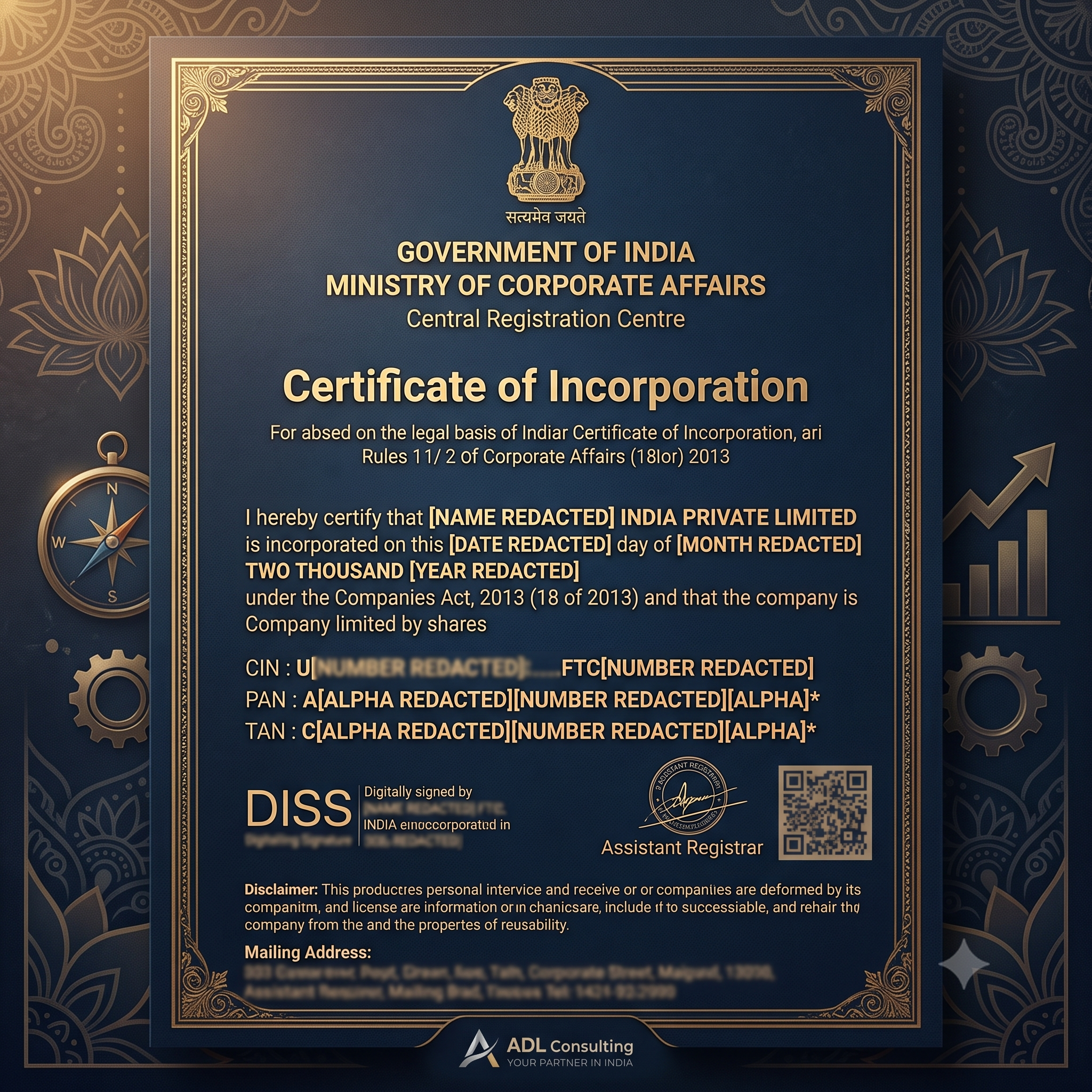
1. What is a Private Limited Company?
A Private Limited Company (hereinafter “Pvt. Ltd.”) is the form most closely comparable to a Korean joint-stock company (jusik hoesa), and is the most common foreign-investment entity incorporated under the Indian Companies Act, 2013.
Why do the majority of companies choose this form?
• Separate Legal Entity: It is recognised as a legal entity distinct from the Korean head office, which blocks local legal disputes or risks from being transferred directly to the head office.
• Limited Liability: Shareholders bear liability only up to the amount of the equity they have subscribed.
• 100% foreign ownership permitted: In most sectors, other than certain security-related industries such as defence and telecommunications, a foreign individual (or foreign company) may hold 100% of the shares without prior government approval (the Automatic Route).
• Funding and scalability: Capital increases through share issuance, bank lending and investment fundraising are all straightforward, making this the most advantageous structure for business expansion.
• Choice of tax rate: The company may elect the concessional corporate tax regime of 22% (an effective rate of approximately 25.17% including surcharge and cess), which is more favourable than the 35% foreign-company rate applied to a Branch Office.
1-1. Comparison with other entry structures
We are frequently asked, “Does it really have to be a company? Would a branch or a liaison office not do?” The table below sets out the comparison.
Structure | Approval to establish | Permitted activities | Suited to |
Private Limited Company | Automatic Route for most sectors; registration with the MCA | No restriction — manufacturing, sales, services and so on Can generate local revenue and profit | Most companies planning full-scale operations, local hiring and revenue generation |
LLP (Limited Liability Partnership) | Possible only in Automatic Route sectors | Can trade, but cannot issue shares; FDI constraints apply | Small-scale consulting and professional services with no plans to raise investment |
Branch Office | Approval of the RBI / AD bank required | Limited to the head office's scope of business; manufacturing cannot be carried out directly (except in an SEZ) | A local channel for existing import and export trade; an after-sales service base |
Liaison Office | RBI approval required; normally renewed on a three-year cycle | Market research and liaison work only. Cannot generate revenue or conclude contracts | The market exploration stage, where there are as yet no revenue plans |
Project Office | Established on the basis of an awarded contract | Confined to performance of the project concerned | Companies awarded a specific EPC or construction project in India |
Practical advice: A liaison office is often chosen on the basis that it is a cheap way to start, but it cannot carry out revenue-generating activity at all, and it carries the burden of RBI approval and annual reporting — so it in fact costs more at the point of conversion. If you have revenue plans within three years, starting with a Pvt. Ltd. from the outset is more advantageous in terms of total cost.
2. What changed in 2026 (essential reading)
2026 is the year in which the regulatory environment changed most significantly for companies entering India. If you prepare on the basis of older material, it may diverge from the actual procedure, so please be sure to check the following five points.
Item changed | Nature of the change | Practical impact |
Complete overhaul of the income tax law | The Income-tax Act of 1961 has been repealed, and the Income-tax Act, 2025 takes effect from 1 April 2026 The concepts of ‘Previous Year / Assessment Year’ have been consolidated into ‘Tax Year’ | Rates and taxing principles are largely maintained, but section numbering has been changed throughout. Citations of provisions such as ‘115BAA’ in existing contracts and internal policies need to be reviewed |
Decommissioning of the MCA V2 portal | Electronic filing with the Ministry of Corporate Affairs (MCA) has migrated entirely to the V3 portal; the old V2 portal was retired in 2026 | All forms — SPICe+, AOC-4, MGT-7, DIR-3 KYC and the rest — are processed as web forms on V3. Existing DSCs must be re-associated with V3 |
Easing of FDI restrictions for land-bordering countries | Press Note 2 of 2026 (15 March 2026) and the amended FEMA Non-Debt Instruments Rules (2 May 2026) partially relax the restrictions under Press Note 3 (2020) The beneficial owner test has been narrowed from ‘residence’ to ‘citizenship’, and holdings of less than 10% in aggregate without control are permitted under the Automatic Route | This creates scope for Korean or third-country parent companies with a minority Chinese or Hong Kong shareholding to invest without prior approval. Pakistan and Bangladesh, however, are not covered by the relaxation |
Restructuring of GST rates (GST 2.0) | Following the September 2025 reform, the 12% and 28% brackets have largely been dismantled, simplifying the system around 0%, 5% and 18% (40% for luxury and demerit goods) | Import costs and selling prices need to be recalculated. New businesses assessed as low-risk may use the simplified registration procedure, completed within three working days |
Change to the director KYC cycle | DIR-3 KYC has moved from an annual filing to once every three financial years (amended 31 December 2025, effective 31 March 2026). The due date has also changed to 30 June | The burden is reduced, but there remains a separate obligation to update within 30 days where the address, email address or mobile number changes. The first filing deadline under the transition should be confirmed individually |
3. Minimum requirements for incorporation
The point that causes the most confusion in setting up an Indian company is the requirement as to the persons involved. Please refer to the following in deciding the initial composition of the company.
Item | Requirement | Key points |
Shareholders | Minimum 2 | May be composed of a company plus an individual, or two individuals The usual structure is [Korean head office 99.99% + CEO in personal capacity 0.01%], taking the form of a wholly owned subsidiary. Up to 200 shareholders are permitted, and share transfers are subject to restrictions under the articles of association. |
Directors | Minimum 2 | A shareholder and a director may be the same person. Every director must obtain a DIN (Director Identification Number), and up to three may be issued simultaneously with the incorporation application. |
Resident Director in India | Minimum 1 | Section 149(3) of the Companies Act: at least one of the directors must stay in India for 182 days or more during the relevant financial year (1 April to 31 March). For a newly incorporated company, the requirement applies proportionately over the remaining period, for the first financial year only. A breach may attract a penalty of up to INR 300,000 on the company and up to INR 100,000 on the officer personally. In the early stage, where no expatriate has been posted locally, the requirement can be satisfied by using the Resident Director support service of a professional firm such as ADL Consulting. |
Share capital | No limit | The minimum capital requirement has been abolished. It is normally set by reference to six to twelve months of initial operating expenses. The Authorized Capital is directly linked to stamp duty and therefore requires separate consideration (see section 5). |
Registered address | An address in India | A local Indian address is required in order to register the company. If you have not yet leased an office, a co-working space or a virtual office may be used. A lease agreement, a no-objection certificate (NOC) from the landlord, and a utility bill issued within the last two months are required as supporting evidence. |
4. The six steps of incorporation
India has simplified the incorporation procedure through an integrated system known as SPICe+ (Simplified Proforma for Incorporating Company Electronically Plus). For foreign applicants, however, documents must be notarised in the home country, so thorough preparation is essential.
Step 1: Preparing the director and shareholder documents
• The passport, passport address page and proof of address (such as a mobile phone bill) of each foreign director must be notarised (Notarization) and apostilled (Apostille).
• The same procedure is required for the passport and proof of address of each foreign shareholder, or of the representative of a corporate shareholder.
• The business registration certificate of a corporate shareholder must also be notarised and apostilled. (Where an English-language certificate of business registration is used, an apostille alone may be sufficient.)
• Proof of address must be dated within the last two months, and the name and address must match the particulars recorded in the passport. This mismatch is the number one cause of rejection.
Step 2: Issuing the DSC (digital signature) and DIN (Director Identification Number)
• A Class 3 Digital Signature Certificate (DSC) is issued in the personal name of each director in order to transact with Indian government authorities. This normally takes one to three working days, and foreign nationals are required to provide a notarised passport and to complete video verification (Video KYC).
• The DIN (Director Identification Number) requires no separate application; it can be obtained at the same time as the incorporation application (SPICe+ Part B).
• Please note the validity period of the DSC. If insufficient validity remains at the point of association with the V3 portal, the association will be rejected.
Step 3: Company name approval (SPICe+ Part A)
• The desired trade name is applied for with the MCA (Ministry of Corporate Affairs). Up to two names may be submitted in order of preference, and the government fee is INR 1,000.
• The approved name is valid for 20 days. If Part B is not submitted within this period, both the name and the fee lapse and the process must be started again from the beginning.
• It is safer to run a search of the MCA database and of the Trade Marks Registry in advance, so as to avoid similarity to an existing trade mark or the inclusion of prohibited words.
• If the trade name is clearly distinctive, it is possible to skip Part A and apply directly within Part B; however, because rejection would nullify the entire application, we do not recommend this.
Step 4: Preparing and notarising the incorporation documents
• On the basis of the approved company name, the various incorporation forms are prepared: the Affidavit, DIR-2 (consent to act as director), DIR-8 (declaration of non-disqualification), INC-9 (declaration by subscribers and directors), MBP-1 (disclosure of interest) and the POA (power of attorney).
• Where directors or shareholders located outside India sign, notarisation and apostille are likewise required.
• Where a director or shareholder signs within India, notarisation and apostille are not required; instead, a copy of the arrival stamp evidencing entry into India is needed. If a business trip is already planned, this route greatly reduces both time and cost.
Step 5: Integrated incorporation application (SPICe+ Part B)
• The MOA (memorandum of association setting out the objects, INC-33) and the AOA (articles of association, INC-34) are prepared and filed.
• Through the linked form AGILE-PRO-S, applications for the PAN (corporate tax number), TAN (withholding tax number), EPFO/ESIC (social security registration), GSTIN, Profession Tax and the corporate bank account are all made at once. AGILE-PRO-S must itself be filed even if none of the individual services is selected.
• Stamp duty is calculated automatically by the system according to the state in which the company is located and the amount of the Authorized Capital.
Step 6: Receiving the Certificate of Incorporation (COI) and the various numbers
• Once the COI (Certificate of Incorporation) is issued, the company is legally constituted. A CIN (Corporate Identity Number) is allotted.
• At the same time, the PAN, TAN and EPFO/ESIC codes are issued electronically.
• However, the actual opening of the corporate bank account is separate from the SPICe+ application and must go through the bank's own KYC review; where there are foreign directors or shareholders, this commonly takes a further two to four weeks in practice. This is the most frequent bottleneck in the overall timeline.
Expected timeline: Where the documents are complete, approximately four to six weeks to issuance of the COI (including the period for notarisation and apostille in Korea). The ROC review itself is processed within seven to ten working days if there are no defects in the documents. Including bank account opening and the remittance of share capital, it is realistic to allow eight to ten weeks before the company is genuinely operational. |
5. Statutory obligations that must be dealt with immediately after incorporation
More important than the incorporation procedure itself is compliance after incorporation. The success or failure of a business in India depends on how accurately local regulations are observed. The key items that must be dealt with within 180 days of incorporation are as follows.
Item | Deadline | Content and risk |
① First board meeting | Within 30 days of incorporation | The directors meet and resolve on such matters as the appointment of the auditor, the opening of the bank account and the confirmation of the registered address. Minutes must be prepared and retained without fail. |
② Appointment of the first auditor | Within 30 days of incorporation | In India, every company is subject to a mandatory statutory audit regardless of the scale of its revenue. The board must appoint a chartered accountancy firm (CA) within 30 days; if it does not, the members must make the appointment within 90 days. There is some doubt in the legislation as to whether ADT-1 must be filed for the first auditor, but in practice it is safer to file it. |
③ Notification of the registered office | Within 30 days of incorporation | This evidences, by means of the lease agreement, utility bills and similar documents, that the registered office is genuinely located at the stated address. If evidence of the address was already attached when SPICe+ Part B was filed, no separate filing is required. |
④ Remittance of share capital and FDI reporting | See separate explanation below | This is the stage at which mistakes most frequently occur. It is dealt with in detail in section 5-1. |
⑤ Declaration of commencement of business | Within 180 days of incorporation | This is the filing that declares: “the share capital has been paid in, so we are now commencing actual operations.” Failure to file attracts a penalty of INR 50,000 on the company and INR 1,000 per day on each officer (up to INR 100,000); borrowing, contracting and other business activity may be regarded as unlawful, and in the worst case the company's registration may be struck off. |
5-1. Remittance of share capital and FC-GPR — the stage most often got wrong
The procedure by which the Korean head office sends the share capital does not end simply with the ‘remittance’. There is a sequence and a set of deadlines prescribed under India's Foreign Exchange Management Act (FEMA), and missing them makes the company liable to a Late Submission Fee (LSF) or to compounding penalties.
The correct sequence is as follows.
• ① Open the corporate bank account, then have the Korean head office remit the share capital.
• ② Obtain from the Indian bank, without fail, both the FIRC (Foreign Inward Remittance Certificate) and the KYC report on the remitter. Without these two documents, the subsequent filings cannot be made.
• ③ Allot the shares (Allotment) by board resolution within 60 days of receipt of the remittance. If 60 days are exceeded, the funds must be refunded within 15 days; if they are not refunded, they are deemed to be a ‘Deposit’ and become subject to separate regulation.
• ④ File FC-GPR on the RBI FIRMS portal within 30 days of the date of allotment of the shares. Registration of the Entity Master (the company's basic particulars) must have been completed beforehand.
• ⑤ At the same time, file PAS-3 (return of allotment) with the MCA within 30 days of the date of allotment. This is a separate obligation under the Companies Act, and it is frequently overlooked.
Critical point: the 30-day period for FC-GPR runs from the ‘date of allotment of the shares’, not the ‘date of receipt of the remittance’. A great deal of published material incorrectly states ‘within 30 days of receipt of the share capital’. The actual trigger is the date of the board resolution allotting the shares. Where the filing is late, the Late Submission Fee (LSF) starts at INR 7,500 and increases in proportion to the amount and the length of the delay. Beyond three years it cannot be resolved by way of LSF at all, and a formal compounding penalty procedure must be followed. On incorporation, the initial subscriber shares (subscribed under the MOA) may be allotted at face value, but any subsequent capital increase requires a Valuation Certificate from an authorised valuer. |
6. Additional registrations depending on the type of business
Receiving the COI does not mean that all registrations are complete. Depending on the sector and the manner in which the business operates, the following additional registrations are required.
• GST registration: This is mandatory once annual turnover exceeds INR 4,000,000 for the supply of goods (INR 2,000,000 in certain states), or INR 2,000,000 for services (INR 1,000,000 in certain states). However, inter-state supply of goods, e-commerce, import businesses and the like must register immediately regardless of turnover. In many cases voluntary registration is advantageous in order to claim input tax credit.
• Profession Tax: In states where it applies — such as Karnataka, Maharashtra and West Bengal — both an employer registration (PTEC) and a payroll withholding registration (PTRC) are required.
• Shops and Establishments registration: This is registration of the place of business under state labour law, and the application is normally made within 30 days of commencing operations.
• IEC (Importer Exporter Code): In order to import or export goods, an IEC must be obtained from the DGFT. It is processed online within a few days.
• Udyam (MSME) registration: If the company falls within the criteria for a small or medium enterprise, benefits such as protection against delayed payment are available.
• Product certification: Electrical and electronic products require BIS (CRS); medical devices and cosmetics require CDSCO; food requires FSSAI; explosive and pressure-related equipment requires PESO; and packaging materials require EPR registration. These are the classic items on which goods get held up at the customs clearance stage, so preparation should begin three to six months before the first import.
• Activation of EPFO and ESIC: The codes are issued on incorporation, but the actual obligation to contribute begins once employee numbers exceed the thresholds of 20 (EPF) and 10 (ESI).
7. The annual compliance calendar
These are the obligations that recur every year after incorporation. Because India's system automatically accrues daily additional fees once a deadline has passed, managing the calendar is itself a form of cost saving.
Item | Deadline | Notes |
FLA return (RBI) | 15 July each year | Annual return of assets and liabilities by a company that has received foreign investment. Failure to comply is a breach of FEMA |
Annual General Meeting (AGM) | Within 6 months of the financial year end (normally 30 September) | For the first year after incorporation, within 9 months of the financial year end |
Filing of financial statements (AOC-4) | Within 30 days of the AGM | Filed on the MCA V3 portal |
Annual return (MGT-7A) | Within 60 days of the AGM | Small companies use MGT-7A |
Corporate income tax return | Normally 31 October (30 November where transfer pricing applies) | The deadline differs according to whether the company is subject to a Tax Audit |
Transfer pricing report (Form 3CEB) | Normally 31 October | Mandatory regardless of amount if there is even a single transaction with the Korean head office |
Director KYC (DIR-3 KYC Web) | Once every three financial years, by 30 June | Moved to a three-year cycle from 2026. A separate update is required within 30 days of any change of particulars |
Quarterly TDS (withholding tax) returns | Quarterly | Withholding on payments such as salaries, service fees and rent, together with quarterly returns |
GST returns | Monthly/quarterly plus annual | GSTR-1 and GSTR-3B, together with the annual GSTR-9 |
DPT-3 / MSME-1 | 30 June / half-yearly | Return of borrowings; return of delayed payments to small and medium enterprises |
8. The cost structure of incorporation
Many people ask, “How much does it cost to set up?” To arrive at an accurate quotation, you need to understand how the cost is structured. It divides broadly into three categories.
① Government fees and stamp duty
• Stamp duty varies according to the amount of the Authorized Capital and the state in which the company will be located.
• If the Authorized Capital is set too high, initial costs increase; if it is set too low, the articles must be amended and a fee paid again on each capital increase. Setting it at the right level is a matter of know-how.
• Up to an Authorized Capital of INR 1,500,000, the MCA incorporation fee itself is waived, and the actual burden consists of state stamp duty and the name application fee (INR 1,000).
② Professional fees
• These are the service fees of a chartered accountancy (CA) firm and a company secretarial (CS) firm, or of a consulting firm that has the same personnel in-house.
• Rather than looking only at the incorporation work, it is more sensible to compare on the basis of total cost including the accounting, tax and ROC filings for the first year after incorporation.
③ Incidental costs
• Translation, notarisation and apostille costs in Korea
• Fees for the Resident Director support service in India — normally charged on an annual basis.
• Rent for the registered address (virtual office or co-working space)
• DSC issuance costs (per director)
9. Five things Korean head offices most often overlook
These are items that cause problems after incorporation rather than at incorporation itself. If they are considered together at the initial structuring stage, they can be resolved at far lower cost.
• 1) Transfer Pricing: Where there are transactions between the Korean head office and the Indian company — supply of goods, royalties, service fees, interest on loans and so on — the arm's length principle applies and the filing of Form 3CEB becomes mandatory. There is no lower monetary threshold. You should document the basis on which prices are determined from the outset.
• 2) The Korea–India tax treaty and withholding tax: When the Indian company pays royalties, technical service fees, interest or dividends to the Korean head office, withholding tax arises in India. To obtain treaty benefits, a Tax Residency Certificate (TRC) and Form 10F are required, and if these are not prepared the higher domestic-law rate applies.
• 3) Permanent Establishment (PE) risk: If an employee of the Korean head office stays in India for a long period and negotiates contracts, India may acquire taxing rights over the head office itself, separately from the company. The role of seconded personnel and their authority to conclude contracts must be clearly delineated.
• 4) The substance of the Resident Director: A resident director is not merely a ‘name’ but a position that carries substantive fiduciary duties and legal liability under the Companies Act. If the role is operated so that the director simply signs without knowing anything of the content, both that director and the company are exposed to risk. The scope of authority and the reporting lines should be made clear by contract, and the role should be designed to function in substance.
• 5) The structure for repatriating funds: How the money earned in India will be brought back to Korea is decided at the time of incorporation. The tax burden and the FEMA procedures differ entirely depending on whether dividends, royalties, service fees or interest are used. Changing route after entering the market requires amendment of the articles and re-execution of contracts, which makes it expensive.
Frequently asked questions (FAQ)
Q1. Does the CEO have to travel to India in person in order to incorporate the company?
No — the incorporation procedure itself can be completed without a visit. All applications are made online, and you simply send to India the documents notarised and apostilled in Korea. However, some banks require an in-person check at the bank account opening stage, so in practice whether a trip is needed at the point of opening the account should be confirmed bank by bank.
Q2. Can an employee based in Korea become the head of the Indian entity?
Yes. However, in order to satisfy the ‘Resident Director’ requirement, one further director who stays in India for 182 days or more during the relevant financial year must be appointed. If no expatriate has yet been posted, the Resident Director support service of a professional firm can be used for the initial stage only.
Q3. When is the share capital remitted?
It is remitted once the bank account in the name of the Indian company has been opened following incorporation (issuance of the COI). After remittance, the KYC report and FIRC must be obtained, the shares must be allotted within 60 days, and FC-GPR must then be filed within 30 days of the date of allotment. Since each stage runs from a different starting point, they need to be managed separately.
Q4. Is 100% sole investment possible without an Indian partner?
Yes. Most sectors — distribution, manufacturing, services, IT and so on — permit 100% foreign investment under the Automatic Route, so a company can be incorporated on a standalone basis without a local partner. Defence, telecommunications, certain retail activities and insurance, however, are subject to equity caps or prior approval requirements, so sector-by-sector confirmation is necessary.
Q5. Is it a problem if some Chinese capital is mixed into the group?
Under Press Note 3 of 2020, prior government approval was required where capital from a country sharing a land border with India — such as China or Hong Kong — was identified as the beneficial owner. Press Note 2 (2026), issued in March 2026, eased the regulation: the test for beneficial ownership has been narrowed from ‘residence’ to ‘citizenship’, and holdings of less than 10% in aggregate without control now qualify for the Automatic Route. The assessment is nonetheless demanding, so it is safer to have your shareholding chart reviewed in advance.
Q6. How much is corporate income tax?
Under the new Income-tax Act, 2025, in force from 1 April 2026, the basic rate for a domestic company is 30%, reduced to 25% where turnover in the immediately preceding tax year was INR 4 billion or less. A concessional rate of 22% (an effective rate of approximately 25.17% including surcharge and cess) may be elected in exchange for forgoing various deductions, and most newly established subsidiaries consider this option. Since the election cannot be reversed once made, the decision must be taken in the early stage after incorporation.
Q7. How long does incorporation take?
Where the documents are complete, approximately four to six weeks to issuance of the COI. However, to reach the point at which the company can actually trade — with the bank account opened, the share capital remitted and the FDI reporting completed — it is realistic to expect around eight to ten weeks.
Q8. Can we incorporate at a virtual office address, without an office?
Yes. A lease agreement, a landlord's NOC and a recent utility bill are required, and because physical verification may be carried out during the GST registration review, it must be an address at which documents can genuinely be received. In addition, tax jurisdiction in India differs from state to state, so registering in the state where you will actually do business is the way to reduce later relocation costs.
Q9. Can the company be moved to another state after incorporation?
It can, but the procedure is heavy. Relocation within the same state is relatively simple, whereas moving to a different state requires amendment of the articles, a special resolution of the shareholders, notice to creditors and the approval of the Regional Director, which takes several months. This is why the initial choice of location must be made carefully.
Q10. What should we do if we want to wind the business down?
A company with no trading activity can be struck off through the simplified route (Strike-off) under STK-2, but all periodic filings up to that point must have been completed. Once unfiled returns accumulate, strike-off itself becomes impossible and the additional fees for default continue to mount. “Let us just leave it for now” is the most expensive choice of all.
In closing
ADL Consulting goes beyond merely processing paperwork. Drawing on ten years of experience in successfully establishing more than 100 companies in the Indian market, we provide integrated support — from designing the initial corporate structure through to post-incorporation accounting, tax and administrative management, product certification and licensing.
In particular, the transfer pricing, fund repatriation structure and Resident Director arrangements discussed in this article cost almost nothing if they are decided at the time of incorporation, but cost several times as much to change later. We would encourage you to consult us in advance, while you are still at the stage of evaluating entry.
We hope you will fling open the door to India — complex as it is — together with professionals who have the most accurate information and the deepest experience.
Contact ADL Consulting today and fasten the first button of your entry into the Indian market.
This material has been prepared on the basis of the Indian Companies Act, 2013, the Foreign Exchange Management Act (FEMA) and related regulations, the Income-tax Act, 2025, and the FDI policy (Press Note 2 of 2026), each as in force on 30 July 2026. Indian legislation is amended from time to time and its application may differ according to individual circumstances, so please obtain professional review before making any actual decision.